
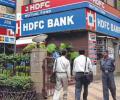
Host of lenders led by State Bank of India (SBI) and Bank of India hiked lending rates after the Reserve Bank raised the benchmark interest rate to tame inflation. The hike has been effected in their benchmark rate linked to the repo rate, which increased by half a percentage point to 5.9 per cent. Even financial institutions like mortgage lender HDFC Ltd hiked the lending rate by 50 basis points effective Saturday.

Every banker loves the four-letter word Casa as it plays an important role in lowering the cost of deposits. Every bank wants to increase its Casa, as a higher portion of Casa in the overall deposit liability brings down its cost of money, points out Tamal Bandyopadhyay.

With the fiscal deficit target staring at the government, the FY25 Budget has limited expenditure options, points out A K Bhattacharya.

Fitch Ratings on Thursday raised its forecast for India's economic growth to 7 per cent for the next fiscal year starting April 1 on the back of strong domestic demand and sustained level of business and consumer confidence. With a stronger-than-expected 8.4 per cent growth in gross domestic product (GDP) during the third quarter (October-December) of the current fiscal year, Fitch saw the Indian economy expanding 7.8 per cent in 2023-24 financial year (April 2023 to March 2024), marginally higher than the government's estimate of 7.6 per cent.

Shifting to floating rate deposits can work as an anaesthetic gel for some customers, points out Tamal Bandyopadhyay.
But there are challenges, observes Tamal Bandyopadhyay.

Structural reforms, pro-people programmes and employment opportunities helped the economy get new vigour, the finance minister said. After contracting by 5.8 per cent in 2020-21, the economy recorded a growth of 9.1 per cent in 2021-22.

Union Finance Minister Nirmala Sitharaman on Monday said banks need to focus more on being customer-friendly so that the process of availing credit becomes more hassle-free for borrowers. However, the minister made it clear that banks do not have to be lenient on credit underwriting standards by taking any adverse risks on a proposal. At a meeting between industry representatives and the finance minister, a startup founder in the baking business suggested for credit to be available hassle-free, to which largest lender SBI's chairman Dinesh Kumar Khara said a startup's worries are more on the equity side and assured full support in lending if sufficient equity is on the table.

If the earnings in the first quarter of the current financial year are an indication, most banks, particularly those majority-owned by the government, have fared well, reveals Tamal Bandyopadhyay.

The RBI's decision to tighten norms for unsecured personal loans is credit positive because lenders will need to allocate higher capital for such loans, thus improving their loss-absorbing buffers, Moody's Investors Service said on Monday. The Reserve Bank last week raised risk weights on unsecured retail loans, credit cards and lending to non-banking finance companies (NBFCs) by 25 percentage points. Moody's said unsecured loans have been growing rapidly in the past few years, exposing financial institutions to a potential spike in credit costs in case of sudden economic or interest rate shocks.

A day after the Reserve Bank of India's (RBI's) Monetary Policy Committee hiked the policy repo rate by 50 basis points (bps), several commercial banks, including ICICI Bank and Bank of Baroda, raised their external benchmark-linked loan rates by an equal amount on Thursday. HDFC, the country's largest mortgage lender, too, increased its interest rates on housing loans by another 50 bps. In total, it has raised rates by 85 bps since May 4, when the RBI had increased the repo rate by 40 bps in an off-cycle meeting.

The home loan top-up, a kind of secured multipurpose personal loan, is on the regulator's radar, points out Tamal Bandyopadhyay.

For Lori Beer, chief information officer, JPMorgan Chase & Co, largest banker in the US, India is a big part of the organisation's global technology footprint and is core to its products and services. This is evident from the fact that in less than two months since JPMorgan & Chase chief executive officer Jamie Dimon visited India, Beer has come here to see the recently opened centres in Mumbai and Bengaluru. "What is different for me this year are our new centres and to be able to come and see the vibrancy, and connectedness is great.

The top 50 exposures, amounting to Rs 7.8 trillion, of government-registered non-banking financial companies (G-NBFCs) constitute about 40 per cent of corporate credit within the NBFC sector, indicating concentration risk, according to the Reserve Bank of India's report "Trend and Progress of Banking in India 2022-23". Notably, all the 50 are tied to the power sector, a domain fraught with inherent challenges, the report said. The report highlighted recognising the escalating systemic importance of G-NBFCs, the Prompt Corrective Action (PCA) framework had been expanded to include G-NBFCs excluding those falling within the base layer.

The Centre should privatise all public sector banks (PSBs), except the State Bank of India (SBI). This is because private banks have emerged as a credible alternative to PSBs with substantial market share. Also, government ownership hinders the ability of the Reserve Bank of India (RBI) to regulate the sector, according to a report by the National Council of Applied Economic Research (NCAER).

While the economy seems to be on a firm growth path, the fight against inflation is not over yet. Shaktikanta Das seems to be in no hurry. After playing well through a five-year Test match, he doesn't want to get out hit wicket, observes Tamal Bandyopadhyay.

Concerned over inflationary pressures in the economy, the Reserve Bank of India (RBI) is bringing down surplus liquidity in the system rapidly. It has fallen to pre-Covid levels and almost 2 per cent of banks' net demand and time liabilities (NDTL). NDTL shows the difference between the sum of demand and time liabilities (deposits) of a bank (with the public or the other bank) and the deposits in the form of assets held by the other bank.

Why is the RBI harsh on Paytm Payments Bank? Why did it give Rana Kapoor of Yes Bank Ltd such a long rope?Often, it's a long investigation process, but the RBI doesn't discuss this openly since that can threaten financial sector stability, explains Tamal Bandyopadhyay.

The banking regulator was uncomfortable with the runaway pace at which consumer credit was growing.

Many individual states experienced higher inflation than the all-India figures during the financial year 2023-24 (FY24). Retail inflation figures in Telangana, Haryana, Rajasthan and Dadra and Nagar Haveli have been higher than national numbers every month of this financial year, shows a Business Standard analysis of state-wise figures, after the March inflation data was released on Friday. Experts noted that persistent high food inflation along with differences in the weights of rural and urban indices plays into the regional variation in inflation rates.

Notwithstanding the recent sharp decline in the stocks of public sector companies, analysts at Jefferies remain bullish on this segment. State Bank of India, Coal India, and NTPC are their top picks in this space, they said in a recent note. The public sector undertaking (PSU) or state-owned enterprise (SOE) index, with a 70-percentage-point outperformance versus the National Stock Exchange Nifty50 over the past 12 months, comes after a decade of underperformance before 2020.

The Reserve Bank of India's (RBI's) latest order on unsecured loans is set to hit the banking sector's growth in the near-term, cautioned analysts, as they see banks slowing down on aggressive retail lending. Besides, cost of funds for non-banking finance companies (NBFC) is expected to inch up as banks will pass on higher capital charge to NBFCs. "We believe the fallout of the RBI action will be mainly on growth, given the rising dependence on unsecured retail loans and lending to NBFCs for growth.

'Understand how wedding expenses fit into your overall financial situation.' 'Evaluate how different levels of spending will impact other goals like retirement, travel, or housing.'

'It is advisable to stay away from the markets for now and buy only on a dip.'

An improved showing of mutual funds (MFs) is helping the industry attract distribution talent at a brisk pace. The industry has onboarded a net of 11,600 individual distributors in the first seven months of 2023-24 (FY24) compared to just 5,555 distributors in the whole of 2022-23 (FY23), according to data from the Association of Mutual Funds in India. Like most financial products, MFs also have significant reliance on individual distributors to sell their products, even as digital platforms are gaining popularity.

As the policy rate has seen a steady increase since May 2022, the percentage of loans offered at interest rates below 8 per cent have declined sharply, dropping from 53 per cent in March 2022 to 18 per cent by June 2023, according to a report by the Reserve Bank of India (RBI). The share of bank loans with interest rates of 10 per cent or higher rose from 22 per cent to 34 per cent during this period, reflecting the impact of a 250 basis point (bps) hike in the policy repo rate by the RBI's Monetary Policy Committee. In response to the rise in repo rate, 32 domestic banks have made corresponding upward revisions to their repo-linked external benchmark-based lending rates (EBLRs), aligning them with the magnitude of the rate hike.

Few finance ministers announce any taxation measure that could upset the stock market. Ms Sitharaman decided to take that risk, observes A K Bhattacharya.

'Israelis arrested us before this war and continue to do so -- even more so -- now.'

The top 100 companies have accounted for 63% of the gains (Rs 51 trillion out of Rs 81 trillion), while firms beyond the top 100 have contributed 37 per cent (Rs 30 trillion).

The IMF on Tuesday projected a growth rate of 6.1 per cent for India in 2023, which is a 0.2 percentage point upward revision compared with the April projection. This is reflective of the "momentum" from stronger-than-expected growth in the fourth quarter of 2022 as a result of stronger domestic investment, the International Monetary Fund (IMF) said. "Growth in India is projected at 6.1 per cent in 2023, a 0.2 percentage point upward revision compared with the April projection," it said in its latest update of the World Economic Outlook.

'To the believers of crypto regulations, I have only one question to ask, how will you regulate it?'

'I think some of us, like Mukesh Ambani, myself and those of us who head industrial units, ought to really focus on what we can really do to make the world a safer place, maybe 50 or 100 years from now.' 'For instance, how can we deal with climate change and global warming, right now?' 'The effects of it may not be felt now; in fact, we may pay a price for it today, but it will help the generations to follow.'

India Inc's net profit as a percentage of the country's gross domestic product (GDP) is just shy of reaching 5 per cent, bolstered by strong earnings growth in the second quarter of 2023-24. Analysts interpret this as an indication that a corporate profit upcycle is in progress, with projections suggesting that this share could exceed 8 per cent within the next five years, driven by bullish earnings growth expectations. "We believe we are only halfway through a profit cycle, with the profit share in GDP rising from a low of 2 per cent in 2020 to about 5 per cent currently, and likely heading to 8 per cent in the coming four to five years. "This implies about 20 per cent compounding of earnings growth. "Underscoring this forecast is the start of a new private capex cycle, under-geared balance sheets, a healthy banking system, lower corporate tax rates, improving terms of trade, and structural consumption demand outlook albeit somewhat offset by likely consolidation in government deficit," said Ridham Desai, managing director, head of research, Morgan Stanley India in a note.

In the June quarter of FY24, 51 per cent of consumers who took small-ticket personal loans already had more than four credit products at the time of accessing yet another new loan, compared with just 17 per cent in the June quarter of FY20, points out Tamal Bandyopadhyay.

At interactions last week with senior officials from the Reserve Bank of India, select banks gave feedback on two key bond market concerns, namely, recent volatility in the rupee-dollar exchange rate and heavy losses incurred on floating rate government bonds due to a demand-supply mismatch, sources told Business Standard. The discussions were held ahead of the RBI's next monetary policy statement, scheduled on August 5. Indian banks are large holders of government securities because of a regulatory mandate to set aside a certain percentage of deposits in sovereign bonds.

Gandhi said farmers asked him during his Bharat Jodo and Bharat Jodo Nyay yatras about why they were not getting the benefit of loan waivers like billionaire industrialists or MSP (minimum support price) for farm produce.

'If the NDA comes to power with 320-330 plus seats, then we could see some correction. We could possibly see a level of 19,500 to 20,000.' 'If the NDA comes to power with a majority of 400-plus, we could see the markets going to about 23,500-24,000 levels.' 'And from there we could see some correction because markets are expensive at this point of time and a correction is overdue.'

The Reserve Bank is likely to maintain status-quo on the key interest rates for the third time in a row in its upcoming bi-monthly policy review despite the US Federal Reserve and the European Central Bank hiking benchmark rates, as domestic inflation is within the RBI's comfort zone, say experts. The borrowing cost which started rising in May last year has stabilised with RBI keeping the repo rate unchanged at 6.5 per cent since February when it was raised from 6.25 per cent. In the previous two bi-monthly policy reviews in April and June the benchmark rate was retained.

The stimulus measures include extension of the 90-day moratorium on recognition of impaired loans to 180 days, in addition to several relaxations in bank lending limits, including allowing banks to fund interest on working capital loans.

India spends significantly less on defence than could be expected from a country that faces simultaneous armed threats from two hostile neighbours -- China and Pakistan.
 © 2026 Rediff.com - Advertise with us - Disclaimer - Privacy Policy - Sitemap - Feedback - About us - Terms of use - Grievances